

Adventure Racing
Joanna Di Grigoli: “Racing at home can be a curse”
They know every ridge, every valley, every line of cloud. Yet when it matters most, the home skies don’t always play fair with athletes, according to Joanna Di Grigoli, Red Bull X-Alps race expert.
Between Turnpoints 9 and 10 of Red Bull X-Alps 2025, Rémi Bourdelle (FRA5) made a bold move. Trusting his local knowledge, the French athlete split from the group and followed a line along a ridge further west, hoping it would work better. “It was a planned move,” explained his supporter Arthur Moindrot.
While flying parallel to the group, Rémi realized other athletes were making better progress. But it was already too late, and he had no choice but to continue. Reality hit: the home advantage had just turned into a setback.

Rémi Bourdelle (FRA5) flies towards Courmayeur during Red Bull X-Alps 2025
© zooom / Maximilian Gierl
The home trap
This moment captured a recurring paradox in adventure racing – the home-turf curse. Athletes competing on familiar ground, for example in Formula 1, sometimes seem more vulnerable. But why does knowing the terrain so well lead to mistakes?
When you’re local, you often fly from memory. You do what you've always done, what has been done for years, what other pilots have taught you, and nowadays, what has been posted online.
In contrast, athletes new to an area tend to see the place with a fresh set of eyes, not necessarily biased by what others have done before. They analyze the route and make decisions on the go, sometimes resulting in very interesting and never-before-seen lines.
Even eagles can fall
During this year’s race, being a local seemed to have been a curse for other athletes who made mistakes on their home turf. Even the greats aren’t immune.
Former Red Bull X-Alps champion Christian Maurer (SUI1) also made two costly errors on home soil. On Day 3, 63 km from Turnpoint 7 - Disentis Sedrun, he split from the group, seeking a shortcut. Chrigel took a more direct route to gain an advantage, only to end up low. He lost the leading pack and had to return to the route the others had taken.

Christian Maurer (SUI1) on Day 3 of Red Bull X-Alps 2025 in Stilfs, Italy
© zooom / Lukas Pilz

Chrigel Maurer at TP7 on the morning of Day 4 of Red Bull X-Alps 2025
© zooom / Lukas Pilz

Team SUI1 hiking up to Pazolastock on Day 4 of Red Bull X-Alps 2025
© zooom / Maximilian Gierl
The challenge didn’t stop there: After taking the lead the next morning, the Swiss Eagle tried to outsmart the gaggle once again and went for a deep line through the Grimselsee. But he ended up getting stuck, lost precious time, and was caught by the others. According to race reporter Gavin McClurg: “Chrigel’s line is completely novel. […] If he pushes south into the Rhone, that’s ‘normal,’ but if he flies that direct line toward the Wetterhorn… I've never seen that done.”
Chrigel's supporters claimed, they were not aware of this decision. "He doesn't always share his plans with us," they explained.
The curse of comfort
Sometimes emotions can take over when making decisions. Davide Sassudelli (ITA4), nearing the Swiss-Italian border, felt a rush of relief to be back in familiar territory. “I couldn't wait to arrive in Italy, because things would be easier with the language", said Davide. But the Italian athlete ended up violating airspace: “It was more of a tactical error, because I thought I'd find lift on the ridge I was heading to. But I got flushed instead and was pushed toward the airspace."
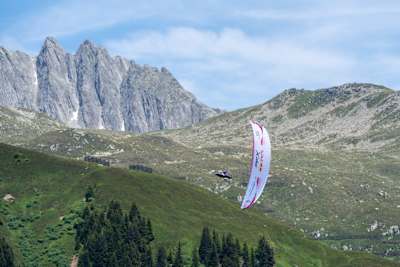
Davide Sassudelli (ITA4) performs in Disentis during Red Bull X-Alps 2025
© zooom / Lukas Pilz
Across these examples, a pattern emerges. Racing at home can cloud judgment. And it can quickly turn from comfortable to constraining, proving that the "curse" might just be real after all.
While familiarity might seem like an advantage, it often leads athletes to rely too heavily on past experiences or expectations, instead of staying adaptable and reading the conditions in real time. Locals may feel increased pressure to perform or assume they "know better," which can backfire in a race where flexibility and fresh perspective are often more valuable than local knowledge.
In the end, with its unpredictable weather, challenging terrain, and constant decision-making, Red Bull X-Alps doesn’t reward those who know the mountains best, but those who can adapt, innovate and listen to them.


